
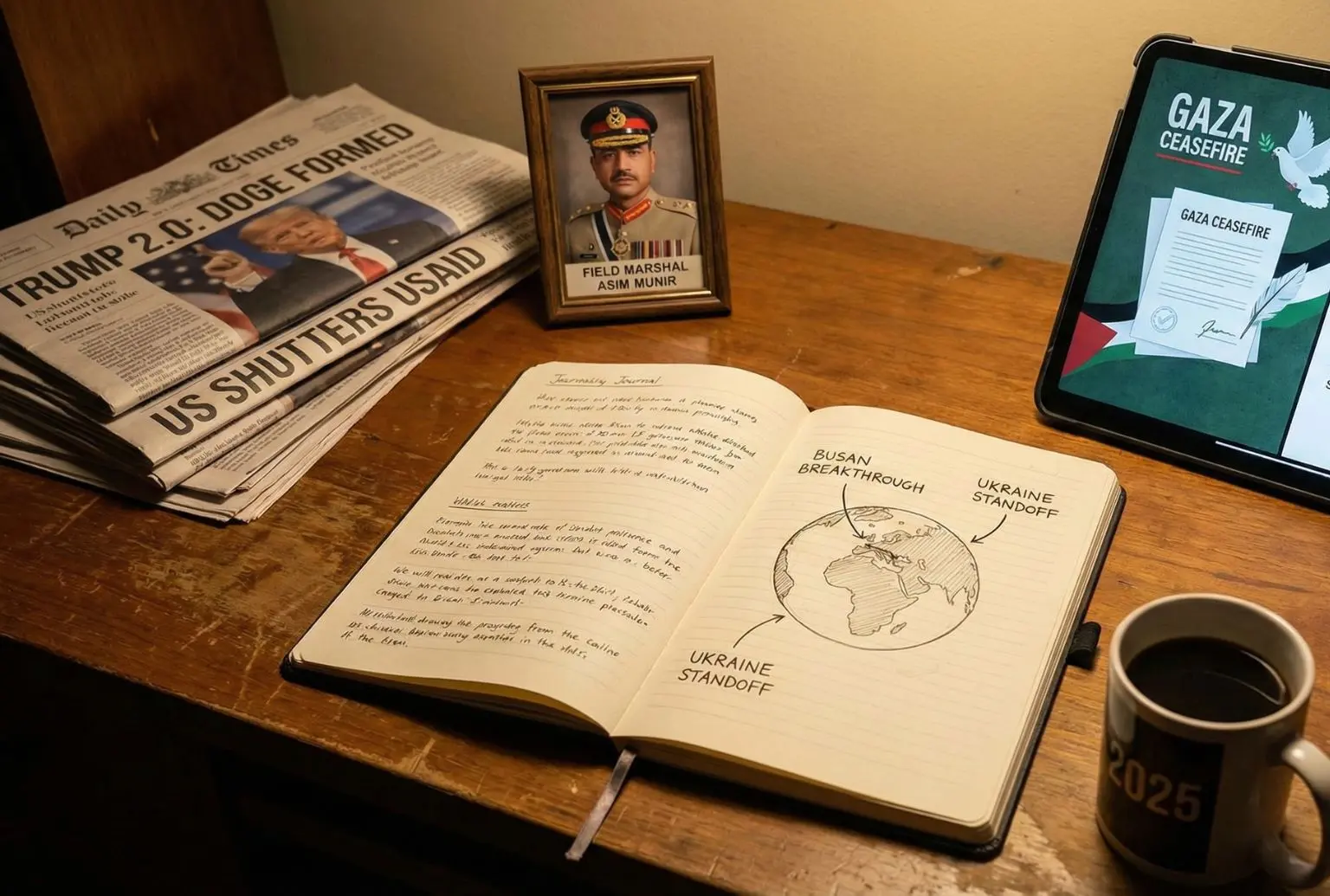
As 2025 comes to a close, this report highlights the Great Reset, from Trump’s return and the restructuring of U.S. governance to Pakistan’s military transition under Field Marshal Asim Munir. It examines Middle East upheaval with Syria’s collapse and the Iran–Israel conflict, Europe’s political shift to the right, US–Russia land-for-peace talks in Alaska, and medical breakthroughs in gene therapy and organ transplantation that reshaped global health and the world order.
USA: The Return of Trump 2.0 and the “DOGE” Era
The political year began with a seismic shift on January 20, 2025, as Donald Trump was inaugurated as the 47th President of the United States. His return to the White House was marked by an immediate and aggressive overhaul of the federal government. One of his first acts was the creation of the Department of Government Efficiency (DOGE), aimed at cutting trillions in federal spending.
By July 1, the administration made the historic decision to officially shutter the USAID agency, signaling a complete pivot toward “transactional diplomacy.” On the economic front, a baseline 10% tariff was imposed on all global imports, fundamentally altering international trade routes. In the tech and health sectors, the FDA made waves by approving Neffy, the first needle-free epinephrine spray, and VIZZ, revolutionary eye drops for age-related farsightedness.
Pakistan: The Elevation of the Field Marshal
For Pakistan, 2025 was a year of immense military and constitutional recalibration. Following a period of high regional tension and a successful defense during the May missile crisis with India, the Parliament passed the 27th Constitutional Amendment. This amendment created the post of Chief of Defence Forces (CDF) to ensure a unified military command.
On December 4, 2025, in a historic ceremony, General Asim Munir was elevated to the rank of Field Marshal and appointed as the nation’s first CDF for a five-year term. Domestically, the government maintained a strict stance on accountability; on December 13, a military court sentenced former DG ISI Lt Gen (retd) Faiz Hameed to 14 years of rigorous imprisonment. Additionally, the interior ministry recommended a formal ban on the Tehreek-e-Labbaik Pakistan (TLP) in October to ensure internal stability.
The Middle East: The 12-Day War and the Assad Collapse
The Middle East underwent a total reconfiguration in 2025. The year began with the collapse of the Assad regime in Syria, ending decades of Ba’athist rule as rebel forces captured Damascus. However, regional stability faced its greatest test in June, when a direct 12-day aerial war broke out between Israel and Iran.
This conflict reached a peak on June 21, when the U.S. conducted targeted strikes on Iranian nuclear facilities to prevent a breakout. Diplomacy eventually prevailed on October 10, when a 20-point Gaza ceasefire plan was brokered, overseen by an international Board of Peace. This deal remains a fragile but essential cornerstone of the current regional truce.
Europe: The Rightward Shift and the Ukraine Standoff
Europe’s political landscape turned sharply conservative in 2025. In May, Friedrich Merz was elected Chancellor of Germany, immediately pivoting the continent’s largest economy toward a “war-capable” defense posture. The Vatican also saw a historic first on May 8, with the election of Pope Leo XIV (Robert Francis Prevost) as the first American-born Pope.
Regarding the Ukraine conflict, the Anchorage Summit in August between President Trump and Vladimir Putin became the defining diplomatic event of the year. While the summit caused friction with some European allies, it established a “land-for-peace” framework that has effectively frozen the frontlines and moved the focus toward long-term reconstruction.
Russia and China: The Busan Breakthrough
The superpower dynamic shifted from confrontation to calculated negotiation in late 2025. Following intense trade friction, President Trump and President Xi Jinping met in South Korea for the “Busan Breakthrough” on October 30. The agreement saw a reduction in fentanyl-related tariffs in exchange for China resuming massive purchases of U.S. agricultural products, successfully de-escalating a potential global economic collapse.
Scientific Breakthroughs: Curing the “Uncurable”
Beyond the battlefields and ballot boxes, 2025 was a year of medical miracles. A landmark in xenotransplantation was reached when a patient survived for a record-breaking 271 days with a gene-edited pig kidney. In the field of genetics, a custom CRISPR therapy successfully saved the life of baby KJ Muldoon, marking the first personalized gene cure in history.
Astronomers also made a once-in-a-century discovery with Comet 3I/ATLAS, the third known interstellar visitor to our solar system. Finally, the battle against HIV saw a major milestone with the widespread adoption of lenacapavir, a twice-yearly injectable that showed nearly 100% efficacy in preventing infection.
Source & Transparency: This newsroom review is synthesized from verified 2025 reports by Radio Pakistan, AFP, The Associated Press, Science Magazine, and official government briefings.