

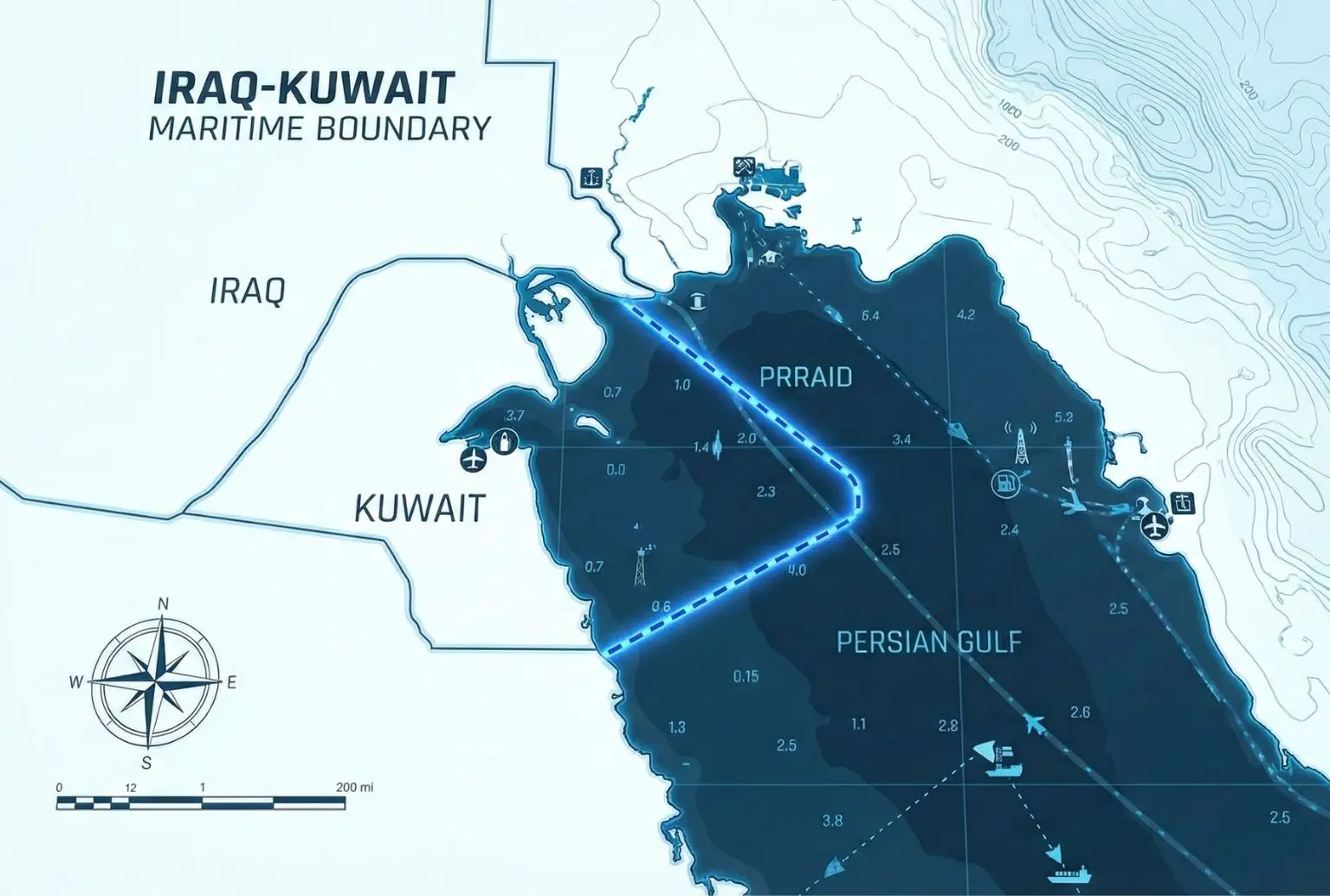
- Kuwait summoned the Iraqi Charge d’Affaires over maritime maps.
- Iraq submitted updated coordinates to the UN Secretary-General.
- Saudi Arabia and Qatar backed Kuwait’s territorial sovereignty.
UN Submission Details
According to a report by the BBC, the Iraqi Ministry of Foreign Affairs confirmed that it has provided the United Nations with updated lists of points and baselines for its territorial waters. These documents were submitted in accordance with the 1982 United Nations Convention on the Law of the Sea. Iraq informed the UN Secretary-General on January 19 and February 9 that these coordinates and the accompanying map would define its maritime zones moving forward.
Technical Mapping Changes
The Iraqi ministry stated that the new documentation is intended to replace maps and coordinates previously submitted in April 2011 and December 2021. The updated files include straight baselines drawn along the low-water line to measure the breadth of the territorial sea. This technical adjustment also encompasses the demarcation of the contiguous zone and the exclusive economic zone which Iraq claims as its sovereign right under international maritime law.
Kuwait Records Protest
The Kuwait News Agency reported that the Ministry of Foreign Affairs expressed deep concern over the unilateral submission by Iraq. Kuwaiti officials stated that the points and maps provided to the UN violate the established maritime sovereignty of Kuwait. The ministry urged Iraq to respect the historical ties between the two nations and to act with responsibility and seriousness in accordance with the provisions of the UN Convention on the Law of the Sea.
Saudi Arabia Reacts
Saudi Arabia has also intervened in the dispute, issuing a statement through its Ministry of Foreign Affairs on social media. Riyadh expressed concern over the maps submitted by Iraq, noting that they include divided submerged areas adjacent to Saudi Arabia and Kuwait. The Saudi government emphasized that the natural resources in these specific areas are the exclusive property of Kuwait and Saudi Arabia, viewing the Iraqi map as a breach of sovereign rights.
Qatar Supports Kuwait
Joining the regional chorus, Qatar issued a statement affirming its support for Kuwait’s territorial integrity. The Qatari Ministry of Foreign Affairs stated that it is closely monitoring the developments regarding the coordinates submitted by Iraq. Doha expressed hope that the principles of international law and the UN Convention on the Law of the Sea would be upheld to resolve the issue. They stressed that any maritime mapping must respect pre-existing agreements and Kuwaiti sovereignty.
Historical Context Conflict
The roots of this maritime tension trace back to the Iraqi invasion of Kuwait in August 1990 under the leadership of Saddam Hussein. Following the 1991 Gulf War, where an international coalition led by the United States liberated Kuwait, the United Nations demarcated the land border between the two countries. While diplomatic relations were restored in 2003 after the fall of the previous Iraqi regime, the maritime aspect of the border remained partially unresolved, leading to the current friction.
Unresolved Border Issues
Despite multiple rounds of negotiations over the decades, the technical demarcation of the maritime boundary beyond a certain point has remained a point of contention. Kuwait and Iraq have struggled to reach a final agreement on the division of waters in the Gulf, which are vital for trade and natural resource extraction. The current submission to the United Nations has brought these dormant issues back to the forefront of regional diplomacy, requiring careful international mediation to prevent further escalation.