

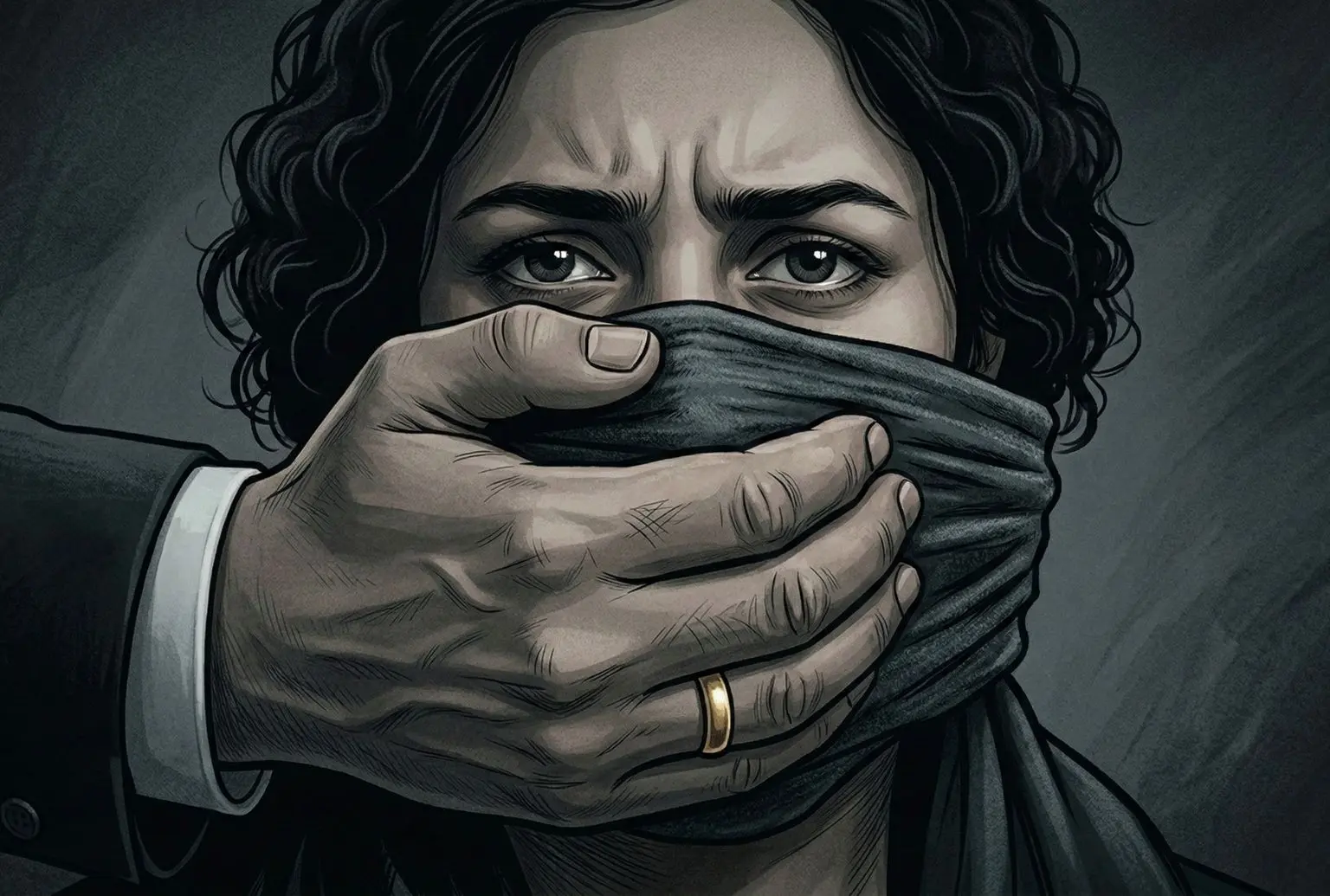
 Digitally Created

When a society silences antithesis, it kills its own synthesis, and without synthesis, the future becomes a mirror of yesterday. Ideas do not emerge from silence. They arise from opposition, conflict, and debate. George Wilhelm Friedrich Hegel described this thing as the dialectic, the process through which ideas evolve. Thus, he explained the following: Thesis: His un assertion or belief. Antithesis: It is a challenge and it’s a contradiction. Synthesis: It is a new and more refined understanding. This interplay of conflicting viewpoints is not an academic concept, it is the engine of intellectual progress, social evolution, and democratic culture.
But what happens when the antithesis is silenced? Debate does not just become difficult, it becomes dangerous. In such a society, ideas stop evolving. In such a society, the future becomes a mirror of the past. And that is the reality of discourse in Pakistan today. There are some figures that expose shocking data. In 2025, World Press Freedom Index, Pakistan descended to 158th place out of 180 countries, one of the lowest global rankings in recent. In 2024, the country was already slipping; but in 2025 it sank further, reflecting a consistent decline in the freedom of expression. Pakistani media freedom score now sits far more below than that of global average. These statistics are not abstract numbers on page. They reflect real pressure that is experienced by the people whose job is to speak the truth to power. But in reality is their job to speak the truth or to hide the truth under pressure? This is an important question that needs an immediate and an honest answer.
In 2025 alone, there are recorded incidents that tell the truth of freedom of speech. Media Freedom Report documented five journalists were killed in Pakistan while other reports suggested eight killings. In 2025, The CPNE report documented that six journalists faced cases, arrests, or official government actions. Also, the report highlighted that two press conferences were blocked. Journalists feared extreme measures, including the freezing of bank accounts and placement on the Exit Control List (ECL) to silence critical voices. The prominent TV anchors and journalists were taken off-air, including Kashif Abbasi, Habib Akram, and others. And all of this has happened as newsroom content across television and the web has grown more uniform and cautious. This is not pressure. That is systemic containment.
The biggest issue is when the families fear punishment more than their duty for questioning the power, the system, the hidden deals, the public loses its mirror. When digital platforms are restricted in the name of “security concerns,” debate is replaced by broadcast narratives. When critical voices are forced to shut down or suffer through legal peril, society begins to self-censor. This then leads to silence and silence becomes survival. And survival becomes the loudest statement. This is the harsh truth of contemporary public discourse, not only in the corridors of media houses, but across social media, universities, and civic spaces.
Pakistan is a state that has its own Constitution. The Constitution of Pakistan of 1973, Article 19 ensures freedom of speech, expression, and the press while allowing for “reasonable restrictions” based on factors like national security, public order, and the glory of Islam. The constitution gives freedom of speech but the lived reality tells a different story. When debate is stifled:
• Critical policy discussions disappear
• Accountability weakens
• Citizens are left repeating official narratives instead of challenging them
• The gap between state power and societal awareness widens
Freedom of expression is not a luxury, it is a fundamental building block of democracy. And when that block weakens, the entire structure is compromised. There are many examples in Pakistan which show how adverse consequences journalists faced when they were simply doing their duty, to question the system, to criticize the system. A renowned investigative journalist and anchor Arshad Sharif fled Pakistan in 2022 after multiple cases were filed against him following his criticism of the military’s role in political shifts. He was assassinated in Kenya in October 2022. While Kenyan police initially claimed it was mistaken identity, Pakistani investigators and a 2024 Kenyan court ruling concluded it was a planned and targeted assassination. Arshad Sharif, a high-profile TV anchor person, was allegedly assassinated.
Toran Rier Khan, a high-profile TV anchor and YouTuber, was forcibly disappeared for over four months in 2023 after being arrested at Sialkot airport. Upon his return, he had lost weight and struggled, and eventually relocated to the UK in January 2025. In CPNE report of 2025, several anchors were specifically named who were either taken off-air or compelled to leave their positions due to institutional pressure:
• Habib Akram
• Arif Harred Bhatti
• Sami Ibrahim
• Khalid Jamil (who also faced arrest in 2025 for social media post)
• Paras Jahanzaib
The hosts that are known for their profound questioning and intent to reason are now either off-air or have to moderate their stances, not due to lack of their talent, but due to fear of professional consequences, fear of society, fear of institutes. After all such devastating circumstances, journalists do not stop speaking because they lack opinions, they stop because speaking carries consequences. When journalists have to calculate survival before publishing facts, democracy is already compromised. Or in a nutshell, when the truth threatens careers, silence becomes the safest headline.
A society without debate or discourse is a society without evolution. There is, indeed, a reason democracies thrive on debate. Healthy discourse, however:
• Exposes flaws
• Encourages understanding
• Promotes accountability
• Generates innovative ideas
If there is no discourse it leads to:
• Citizens repeat narratives
• Policies go unchallenged
• Fear becomes the default dialectic
If a nation cannot question, it does not grow. This discussion is not meant to provoke confrontation. It is meant to encourage institutional reflection. A healthy democracy does not weaken when examined, it strengthens. If public discourse appears to be narrowing, the response should not be defensiveness but reform. The goal is not to assign blame, but to reinforce confidence in systems that serve the public.
The practical areas where constructive improvement can make a measurable difference:
1. Journalism must be treated as a public science, not a professional risk. Legal protections already exist; what matters is consistent and transparent enforcement.
2. Digital regulation is necessary, but clarity is essential. Laws must be precisely defined, transparently applied, and open to independent review.
3. Credibility depends on editorial autonomy. Economic or regulatory pressure should never shape newsroom judgment.
4. Universities should cultivate structured disagreement, not avoid it. Intellectual growth comes from engaging competing ideas. Education must train minds to question, not merely to conform.
Strengthening public discourse requires not only notion, but structured execution. Implementation can be done by following steps:
1. Establish an independent journalist protection commission with representation from media bodies and legal experts. Protection must move from promise to procedure.
2. Introduce independent review panels for cases filed under digital laws. Regulation should be accountable to rule of law.
3. Develop transparent state advertising policies based on objective criteria. Autonomy must be institutional, not informal.
4. Create university-level academic freedom policies with formal protection clauses. Campuses should model civil disagreement, not avoid it.
No state can afford to overlook national security concerns. Yet, long-term stability is strongest when security and open dialogue reinforce one another, rather than compete. Debate should not be mistaken for disorder. It is often the mechanism through which societies correct themselves. Nations grow resilient not by avoiding criticism, but by absorbing it and improving through it. A system that engages with disagreement demonstrates confidence, not weakness. A society must teach to ask questions and people should address them in the most distinguished natural way. The measure of a nation’s strength is not how tightly it controls the conversation, but how confidently it allows it.