

 Radio Pakistan
Analyzing the Fiction Behind US Claims of a Pakistani Intercontinental Missile Threat
The global strategic community was recently taken aback when United States Director of National Intelligence Tulsi Gabbard issued a stark warning to the American Senate. She claimed that Pakistan is rapidly advancing its ballistic missile capabilities to a point where they could eventually put the American homeland within range. This bold assertion immediately triggered a firm rebuttal from Islamabad. Pakistan categorically dismissed the notion, reiterating that its strategic weapons program is exclusively defensive, entirely India centric, and designed solely to preserve national sovereignty and maintain strategic stability in South Asia.
Foreign Office Spokesperson Tahir Andrabi stated plainly that the nation’s missile program operates well below intercontinental ranges. He emphasized that Pakistan relies on the doctrine of credible minimum deterrence against India. Andrabi further pointed out that it is actually India with its missiles capable of reaching up to twelve thousand kilometers that poses a tangible concern not just to neighboring countries but to nations far beyond the immediate region. Pakistan maintains its commitment to constructive engagement with the United States based on mutual respect and factual accuracy, prioritizing regional peace over unwarranted arms races.
The Anatomy of the US Claims
The origin of this recent diplomatic friction stems from an annual threat assessment briefing presented to the US Senate Intelligence Committee. Gabbard grouped Pakistan alongside nations like Russia, China, North Korea, and Iran, stating these countries are heavily investing in research and development of new missile systems capable of delivering both conventional and nuclear payloads. She warned that Pakistan’s long range ballistic missile technology could mature into an intercontinental system capable of striking the United States. Furthermore, she suggested that countries identified in the assessment might attempt to decipher advanced American missile defense projects to refine their own technological trajectories and gauge Washington’s strategic deterrence intentions.
This is not an isolated incident of American apprehension. In September 2024, a senior official from the Biden administration publicly claimed Pakistan had developed workable missile technology that could potentially target the United States. During an event hosted by the Carnegie Endowment, then Deputy National Security Advisor Jon Finer asserted that Pakistan had created long range systems and technologies allowing them to test massive rocket motors. Finer argued that if this trajectory continued, Pakistan would acquire the ability to strike targets well beyond South Asia, raising genuine questions about its long term intentions.
These statements aligned with aggressive actions taken by the Biden administration just days prior. The US government imposed sanctions on four entities allegedly linked to Pakistan’s long range ballistic missile program. These included the National Development Complex, the state run organization responsible for overseeing ballistic missile development. Finer remarked that it was difficult for the US administration not to view these steps as a potential threat, noting that senior leaders had raised these exact concerns with their Pakistani counterparts on numerous occasions.
Ground Reality and Technological Facts
To dissect whether Pakistan actually possesses the intent or the technical capability to build an intercontinental ballistic missile, defense experts offer a much more grounded perspective. Syed Muhammad Ali, an Islamabad based defense analyst, argues that the recent American allegations starkly contradict technical, strategic, and political realities. According to Ali, the modernization of Pakistani ballistic missiles is not aimed at targeting distant continents. Instead, the primary objective is to penetrate and neutralize India’s rapidly advancing ballistic missile defense shields.
The core of this debate centers around MIRV technology, which stands for Multiple Independently Targetable Reentry Vehicles. Ali explains that if an adversary develops a multi layered defense system, a singular ballistic missile might be easily intercepted. To ensure deterrence remains credible, a missile must carry multiple warheads that separate upon atmospheric reentry and independently navigate toward distinct targets. This effectively saturates the enemy defense grid. This is precisely the capability integrated into the Pakistani Ababeel missile.
Ali compares this concept to a formation of fighter jets. As the jets approach a heavily defended target, they scatter in different directions to evade surface to air missiles and anti aircraft artillery, striking the target simultaneously from multiple angles. The Ababeel system operates on this exact principle. It is designed to carry multiple warheads to bypass advanced Indian defense mechanisms like the S400 system, ensuring that Pakistan’s strategic strike capability remains credible. Crucially, developing MIRV technology does not equate to expanding a missile’s maximum range.
Dr. Mansoor Ahmed, a professor of Strategic and Defense Studies at the National University in Canberra, reinforces this point. He notes that until a nation physically tests a missile at a specific range, no one can definitively claim they possess that capability. Pakistan has never tested a missile with a range extending beyond the immediate South Asian theater.
The Shaheen III and Ababeel Systems
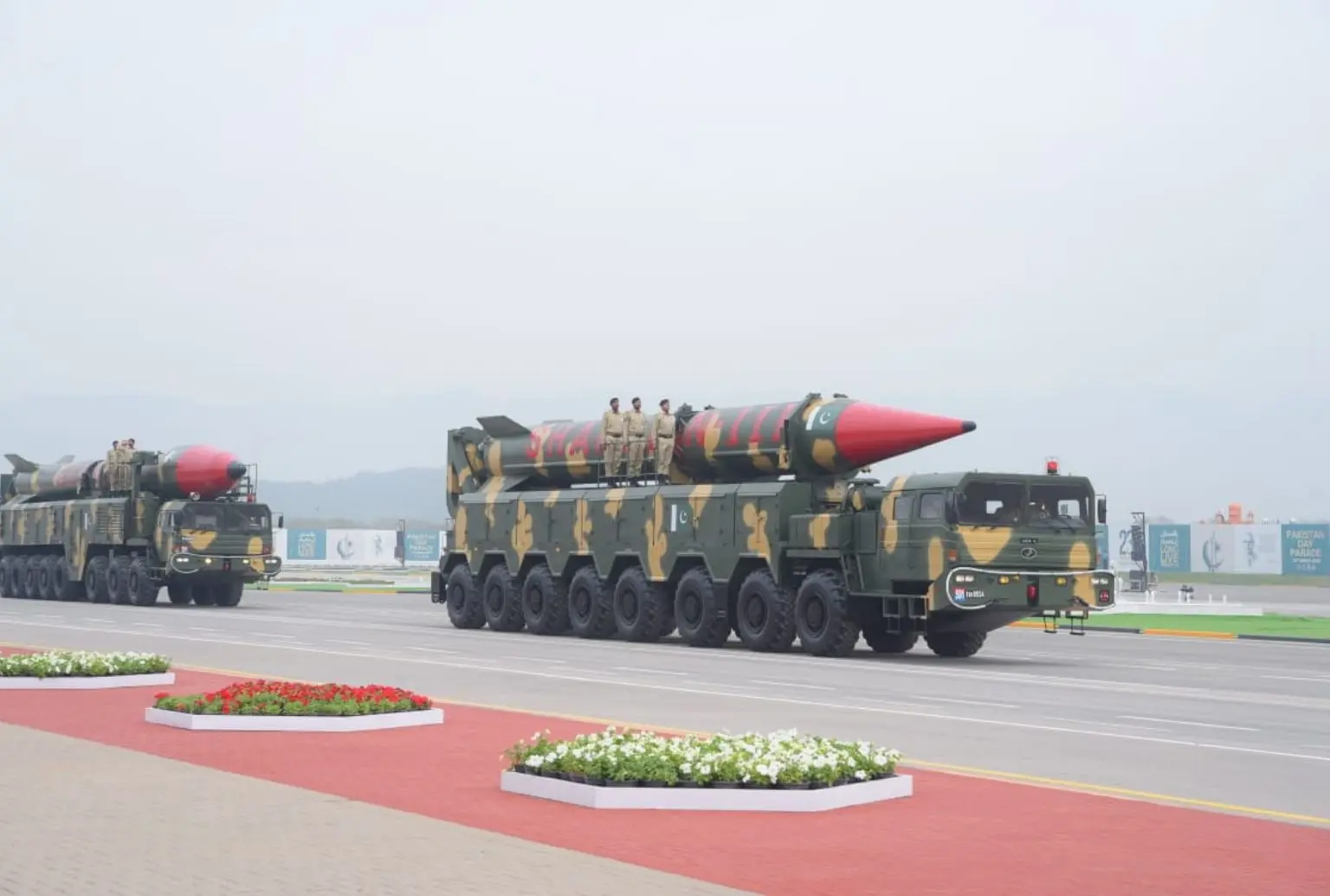
The specific missiles catching Washington’s attention are the Shaheen III and the Ababeel. The Shaheen III is a medium range ballistic missile with a stated operational range of 2750 kilometers. The Ababeel, representing the next evolutionary step in this lineage, has a range of 2200 kilometers but features the sophisticated MIRV payload capability. These systems represent the pinnacle of Pakistan’s current strategic arsenal.
The military media wing confirmed the initial testing of Ababeel in 2017, followed by another critical test in October 2023. The missile was subsequently showcased publicly during the Pakistan Day parade in March. Dr. Ahmed highlights that Ababeel is the first missile in South Asia capable of carrying multiple nuclear warheads over a 2200 kilometer distance. Defense analysts estimate it can carry three or more independent warheads, specifically engineered to defeat Indian ballistic missile defense architectures.
While Ababeel is designed to counter defense shields, the Shaheen III serves a different but equally specific regional purpose. During its initial testing phase, former advisor to the National Command Authority Lieutenant General Khalid Ahmed Kidwai publicly stated that Shaheen III was developed exclusively to counter India. Its 2750 kilometer range ensures that it can reach critical strategic targets located in the Andaman and Nicobar Islands, where India is actively developing nuclear submarine bases. The strategic logic is simple. India must not have any geographical safe havens where it could hide second strike capabilities from Pakistani targeting.
The Glaring Strategic Imbalance
The glaring disparity in how the international community, particularly the United States, treats South Asian missile programs is a major point of contention. While Washington expresses alarm over Pakistan’s 2750 kilometer range missile, India has openly tested the Agni V, an intercontinental ballistic missile boasting a range between 5000 and 8000 kilometers. India is also aggressively advancing its MIRV capabilities on these long range platforms.
Syed Muhammad Ali points out that discussions focusing solely on surface to surface missiles often ignore the massive strategic shift brought about by nuclear powered ballistic missile submarines. India has successfully inducted the Arihant and Arighat nuclear submarines into its naval fleet. These vessels theoretically eliminate range restrictions, as they can be positioned stealthily off the coast of any nation globally. The acquisition of these submarines places India in an elite tier of nations capable of launching nuclear strikes from anywhere in the world oceans.
Furthermore, Indian defense officials have frequently hinted at acquiring preemptive strike capabilities. The accidental firing of a supersonic BrahMos cruise missile into Pakistani territory in 2022 serves as a chilling reminder of the volatile strategic environment. Dr. Ahmed warns that India could potentially utilize systems like BrahMos for a conventional counterforce strike against Pakistani command and control centers. In the fog of war, such an action would almost certainly be interpreted as a preemptive nuclear strike, triggering a catastrophic response. Pakistan must continuously refine its technological edge to ensure India never contemplates such a risky maneuver.
The Real Motive Behind the Sanctions
Despite the clear regional focus of Pakistan’s program, the United States has relentlessly pursued a policy of economic and technological containment through sanctions. The State Department recently penalized companies like the National Development Complex, Akhtar and Sons Private Limited, and several foreign suppliers. The US alleges these entities facilitated the procurement of large diameter rocket motors and specialized vehicle chassis for mobile launchers.
The concern regarding large rocket motors hints at another underlying American anxiety, which is Pakistan’s ambitions in space. Pakistan has a stated vision for a comprehensive space program by 2047. Dr. Ahmed explains that mastering space launch vehicle technology is deeply intertwined with nuclear deterrence, as it enhances precision targeting and satellite based strategic reconnaissance. The United States harbors concerns that a successful civilian space launch vehicle could easily be dual purposed into an intercontinental ballistic missile capability.
However, experts believe these sanctions will do little to derail Pakistan’s strategic trajectory. The missile program has been largely indigenous and self sustaining for decades, forged under the immense pressure of international embargoes dating back to the 1970s. Similar to how harsh sanctions failed to stop other nations from developing advanced weaponry, diplomatic pressure is unlikely to force Pakistan to compromise on what it views as an existential national security imperative.
Ultimately, the aggressive posturing from Washington may have less to do with a genuine fear of a Pakistani strike on American soil and more to do with broader geopolitical maneuvering. The United States views India as the critical linchpin in the Quad alliance designed to contain Chinese influence across the Indo Pacific region. By targeting Pakistan’s defense supply chains, Washington is indirectly applying economic pressure on Beijing while simultaneously appeasing Indian lobbying efforts in the American capital.
Meanwhile, the idea that Pakistan would ever target the United States remains an economic and political absurdity. The US is Pakistan’s largest export market, a vital source of diaspora remittances, and a crucial backer for essential macroeconomic support from international financial institutions. Thus, the notion of Pakistani intercontinental missiles threatening America appears to be a narrative built entirely on strategic anxiety rather than actual ground reality.