
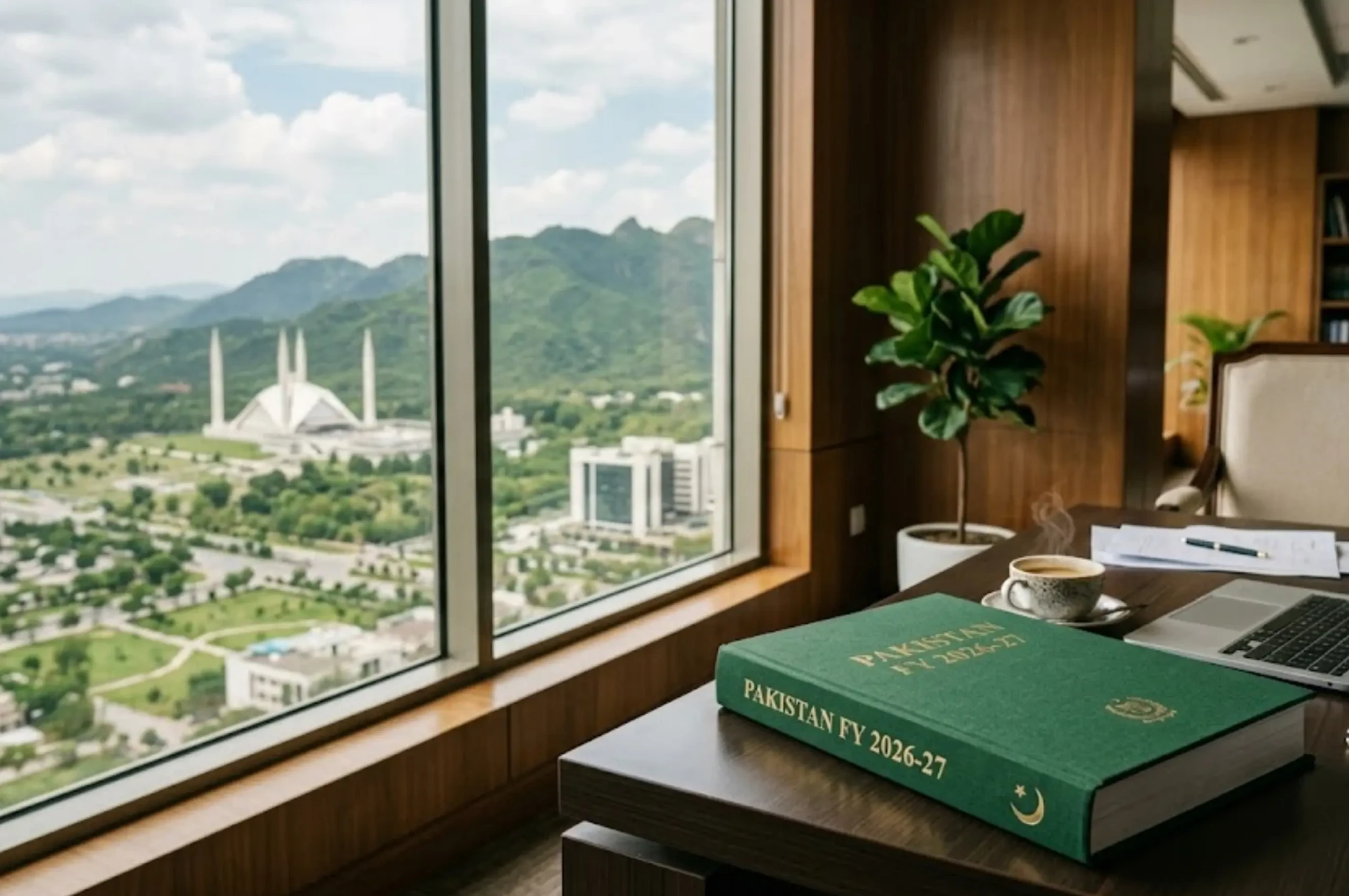

A nation’s future is not always lost in a war or crisis: Sometimes it is indeed lost in financial decisions. The same story is told by the recent budget presented for Fy 2026-27 by institutions.
A budget is a yearly plan for a country’s future for the coming year, from what place and how much revenue would be collected and where the money would be spent to increase the economy of a state.
A budget is prepared to build the country’s future, but in Pakistan, it is seen to be prepared for debt servicing. The recent budget for FY 2026-27 shows that the revenue would be probably Rs: 19.3 trillion among which Rs: 18.8 trillion is the expenditure of a country.The numbers as Rs: 18.8 trillion is a good amount until the debt servicing arrives.
Once the revenue enters the system, it is immediately divided into pre-committed obligations:
- Debt servicing (largest share of revenue)
- Defence Expenditure
- Salaries and Pensions
- Provincial budget under NFC
- Administrative costs.
After all these sectors, there is only a small amount left for the development purposes which is the actual future of Pakistan.If not all yet, most of the revenue is used in survival of the country making the future development compromised.
The recent budget for FY 2076-27 has been announced which elaborates that among budget,the provinces got according to NFC (National Finance Commission) Award Rs: 8.2 trillion has allocated to four provinces,
- Punjab gets about 51.74% which is around Rs:4.2 trillion plus.
- Sindh gets about 24.55% which is around Rs 2 trillion plus.
- Khyber Pakhtunkhwa gets about Rs: 14.62% which is around Rs: 1.2 trillion plus.
- Baluchistan gets about 9.09% which is about around Rs 700 billion plus.
The budget of Pakistan allocates Rs: 2.55 trillion for Defence, that is indeed appropriate as it is about the security of a state.
The biggest share of the budget is allocated for debt servicing.Budget explains about Rs: 8.2 trillion is allocated for debt servicing which probably turns out to be 42% to 43% of the total revenue.It shows that the most defining feature of Pakistan’s fiscal reality is not revenue or expenditure-it is debt. Almost half of the state’s revenue is already committed before any new decision is made for the country’s future.
Debt is a glitter but certainly is not gold. When a state receives a debt, its economy starts to crawl at the very moment.Debt is not as simple as it spells rather it is far more complex than what people think about it. When a state wants to get or receive the debt from institutions like the IMF, it is not a simple mechanism of receiving debt and afterwards paying the same amount. Instead, at the back,there are interests decided on the actual payments. Institutions like the IMF also provide a list of demands a state has to follow during the formation of the skeleton of a state’s budget.
Institutions demand in budget, as these demands are not fixed rather they depend on specific loan programs. In case of Pakistan, the most common demands under IMF are :
- Increase tax collection to reduce budget deficit and improve government revenue.
- Increase petroleum levy to raise revenue without broadening the fiscal deficit.
- Most of the time to reduce or target subsidies to lower government spending and budget deficit.
- Increase Electricity and Gas Tariffs to reduce financial losses in the energy sector.
- Put Pressure to control government spending to prevent excessive borrowing.
- Strengthen Central Bank Independence to improve inflation control and monetary policy credibility.
Not only officials but also locals suffer immensely from the curse of debt. The locals see a large amount of their salaries are absorbed by taxes, while businesses pass rising production costs on to consumers through higher prices. As a rest,the burden of debt is not only measured in trillions of rupees ;it is felt at the dinner table, in monthly utility bills, in the low purchasing power of households.
Debt is not considered bad, useless; rather it can be very useful and can be a source of development of a state that is used with proper planning and accountability of the officials. Debt is a tool that a state has to decide to use for the better future of a country or to slow down the growth of a country.
Debt is very harmful and slowly eats the economy of every and any country if it is repeatedly used to finance daily government expenses or repay older loans instead of creating new sources of growth. However, the reason Pakistan’s economy is not growing is that most of the debt as well as budget Pakistan is allocated for daily survival of Pakistan in terms to manage current expenditure as salaries,pensions, administrations, security operations, utilities and government funding.
On the contrary, the budget for FY 2026-27, it only allocates Rs:1 trillion for the Public Sector Development Programme (PSDP).The amount Rs: 1 trillion to build roads,dams, energy projects,infrastructure and development schemes,is a little amount for a state’s development. While the a amount Rs: 8.2 trillion is allocated for debt servicing which is eight times more than the amount allocated for the development of a country.
For Pakistan, the solution to this debt cycle is not to avoid debt completely but about charging the purpose of receiving debt. Borrowing should no longer be taken for managing current challenges and setting old debts, instead it ought to be used for an investment of the future. When the borrowed money is utilized in productive areas such as energy projects,infrastructure, technology, exports and industries it can build the economic strength to meet the financial commitments. But it needs accountability, transparency and strong institutions that ensure funds are being effectively used to benefit the public. If every budget continues to pay yesterday’s bills instead of building tomorrow’s Pakistan then the question remains:
Who will finally break this cycle?
Today’s policymakers,reformers or the generations forced to inherit its burden?