

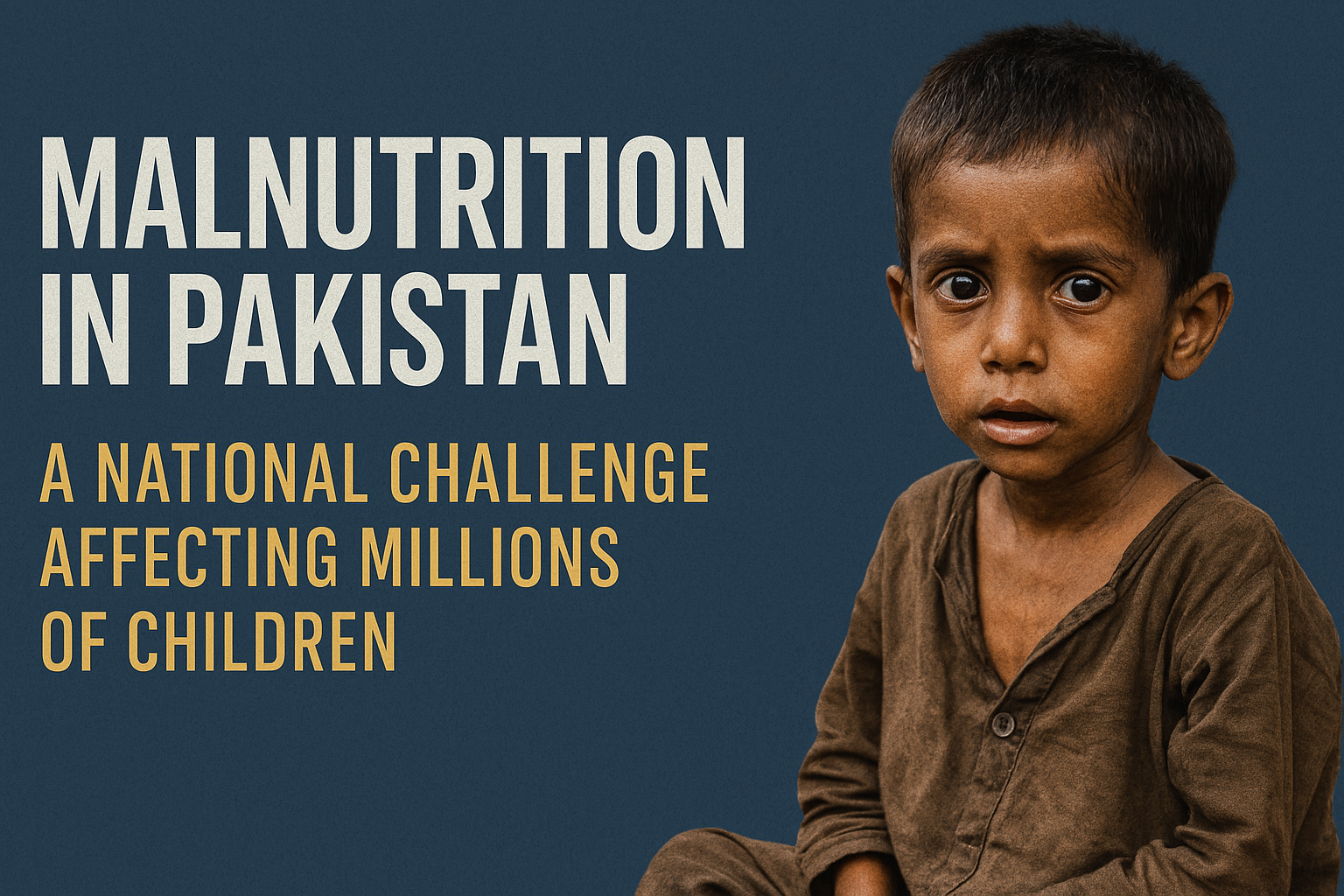
Malnutrition remains one of Pakistan’s most urgent public health challenges, with official figures underscoring the scale of the problem. According to the World Health Organization (WHO) Nutrition Country Profile, 2020, 36.7% of children under five in Pakistan are stunted (low height for age), while 7.1% suffer from wasting (low weight for height). The Government of Pakistan’s Ministry of Finance Economic Survey, 2022 reports that the infant mortality rate is 52.8 per 1,000 live births and the neonatal mortality rate is 39.4 per 1,000 live births — both strongly linked to poor maternal and child nutrition. WHO data from 2018 shows that anaemia affects 58.8% of children under five, 52.2% of non‑pregnant women, and 51.3% of pregnant women, while vitamin A deficiency is present in 51.5% of children aged 6–59 months. Exclusive breastfeeding rates, based on WHO estimates from 2013, remain low at 37% for the first six months of life, with early initiation of breastfeeding at just 19.6%.
Malnutrition in Pakistan — Data at a Glance
| Indicator | Figure | Source & Year |
|---|---|---|
| Children under 5 stunted (low height for age) | 36.7% | WHO Nutrition Country Profile, 2020 |
| Children under 5 wasted (low weight for height) | 7.1% | WHO Nutrition Country Profile, 2020 |
| Infant mortality rate | 52.8 per 1,000 live births | Govt. of Pakistan, Economic Survey 2022 |
| Neonatal mortality rate | 39.4 per 1,000 live births | Govt. of Pakistan, Economic Survey 2022 |
| Anaemia in children under 5 | 58.8% | WHO, 2018 |
| Anaemia in non‑pregnant women | 52.2% | WHO, 2018 |
| Anaemia in pregnant women | 51.3% | WHO, 2018 |
| Vitamin A deficiency in children (6–59 months) | 51.5% | WHO, 2018 |
| Exclusive breastfeeding (first 6 months) | 37% | WHO, 2013 |
| Early initiation of breastfeeding | 19.6% | WHO, 2013 |
| Severely malnourished children treated annually | ~43,000 | UN WFP Pakistan Update, June 2025 |
The United Nations World Food Program (WFP) Pakistan Update, June 2025, notes that in partnership with the Government of Pakistan, approximately 43,000 severely malnourished children are treated each year through targeted nutrition programs. Both WHO (2020) and UN agencies highlight that the crisis is driven not only by food shortages but also by poor dietary diversity, unsafe water and sanitation, and climate shocks such as floods and droughts that disrupt food production. Many households rely heavily on cereals with insufficient protein, fruits, and vegetables, while repeated infections from unsafe water reduce nutrient absorption. These combined factors create a cycle of poor health outcomes, reduced immunity, and increased vulnerability to disease.
In response, the Pakistan Multi‑sectoral Nutrition Strategy 2018–2025 outlines a coordinated approach involving health, agriculture, education, and social protection sectors. Measures include expanding micronutrient supplementation for mothers and children, scaling up fortification of wheat flour, edible oil, and salt, and strengthening community‑based management of acute malnutrition. The WHO, through its Global Nutrition Targets 2025 framework, supports Pakistan in reducing stunting, wasting, and anaemia while improving breastfeeding rates. The United Nations Sustainable Development Goals (SDG) Report 2025 warns that malnutrition undermines human capital, reduces productivity, and perpetuates poverty, making its eradication essential for the country’s health, economic growth, and long‑term stability.