

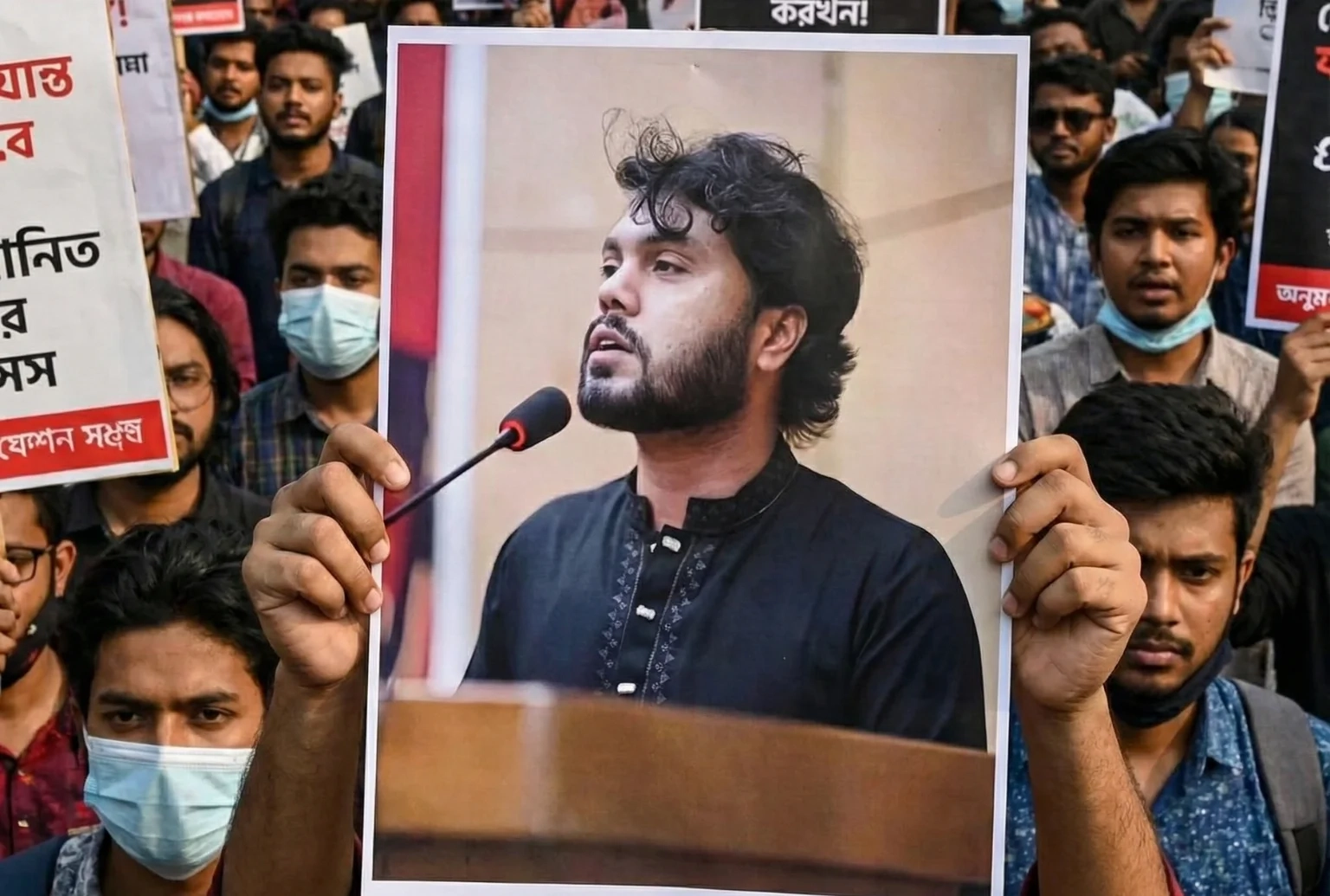
A Student Leader’s Assassination
Sharif Osman Hadi, a 32‑year‑old activist linked with the student organization Inquilab Mancha, was fatally wounded in a targeted shooting in Dhaka last week. According to local accounts, masked gunmen opened fire as Hadi exited a mosque, striking him in the head. He was rushed to Dhaka Medical College Hospital before being transferred to Singapore for advanced neurosurgical care. Despite intensive treatment, he succumbed to his injuries on Thursday.
International media reports note that Hadi was regarded as a vocal critic of India’s influence in Bangladesh and had emerged as a potential candidate for the Dhaka‑8 constituency in the upcoming February elections. His death has been described by observers as both a political and symbolic blow to Bangladesh’s fragile democratic transition.
Outpouring of Anger
News of Hadi’s death ignited widespread unrest across Bangladesh. Within hours, violent demonstrations erupted in Dhaka and other cities. Protesters set fire to major buildings, including the headquarters of two of the country’s largest newspapers, Prothom Alo and The Daily Star.
By Friday morning, the four‑storey Prothom Alo office in Karwan Bazar lay in ruins, with smoke still rising from the charred structure. Firefighters battled the blaze through the night, rescuing journalists trapped inside. The Daily Star office was also attacked, with its lower floors gutted and equipment looted. Staff members described scenes of terror, saying attackers smashed property and stole cameras, hard drives, and personal belongings.
The Editors’ Council president, Noorul Kabir, was harassed by protesters when he arrived at the scene, underscoring the hostility directed at the press. For the first time in its history, Prothom Alo suspended publication, calling the attack “a devastating strike against journalism.”
Cultural and Political Targets
The violence extended beyond media houses. In Dhaka’s Dhanmondi district, the cultural institution Chhayanaut was torched, forcing the suspension of all music academy classes. Protesters also attacked the historic residence of Sheikh Mujibur Rahman, damaging its surviving walls.
In Chittagong, demonstrators stormed the office of the Indian Assistant High Commissioner, pelting stones before police dispersed the crowd with tear gas. Former mayor Mohiuddin’s residence and an Awami League office were also set ablaze.
Government Response
Bangladesh’s interim government, led by Nobel laureate Muhammad Yunus, condemned the violence in strong terms. In a statement, Yunus’s office urged citizens to remain vigilant against “isolated extremist groups” seeking to destabilize the country. He described the attack on Hadi as a “planned assault designed to derail the electoral process,” warning that the unrest could escalate into broader conflict if unchecked.
Security forces, including the army, were deployed in parts of Dhaka to restore order. Roadblocks were set up around Shahbagh, where hundreds of protesters gathered chanting slogans such as “Who are you, who am I? Hadi, Hadi!” and calling for a “revolutionary government.”
Investigations and Suspects
Police have launched a nationwide manhunt for Hadi’s killers. Authorities released images of two prime suspects, Faisal Karim Masood and Alamgir Sheikh, alleged to have crossed illegally from India into Bangladesh before fleeing back across the border after the attack. A bounty of five lakh taka (around USD 42,000) has been announced for their capture.
According to international media reports, at least 20 individuals have been detained in connection with the assassination, though investigations remain ongoing. Border guards have been placed on high alert amid fears of cross‑border involvement.
A Nation in Mourning
Hadi’s body is expected to arrive in Dhaka from Singapore on Friday evening, with a national day of mourning declared for Saturday. Political parties across the spectrum have issued condolence messages, demanding justice and punishment for the perpetrators.
For many Bangladeshis, Hadi’s death symbolizes the vulnerability of young leaders who challenge entrenched power structures. His supporters in Inquilab Mancha hailed him as a “martyr in the struggle against Indian dominance,” while critics warned that the rhetoric risks deepening regional tensions.
The Bigger Picture
The unrest following Hadi’s death highlights Bangladesh’s volatile political climate ahead of the February elections. With former Prime Minister Sheikh Hasina in self‑imposed exile and the interim government promising democratic reforms, the assassination has raised fears of sabotage and foreign interference.
International observers caution that attacks on journalists, cultural institutions, and diplomatic offices reflect not only grief but also organized attempts to intimidate civil society. As Yunus noted, “Assaults on the press are assaults on truth.”
The Road Ahead
Sharif Usman Hadi’s killing has become a flashpoint for Bangladesh’s fragile democracy. The violent backlash, from burning newspaper offices to storming diplomatic missions, underscores the depth of anger and mistrust simmering among the youth. Whether the interim government can contain the unrest and deliver justice will determine if Bangladesh’s democratic transition survives this turbulent moment.