

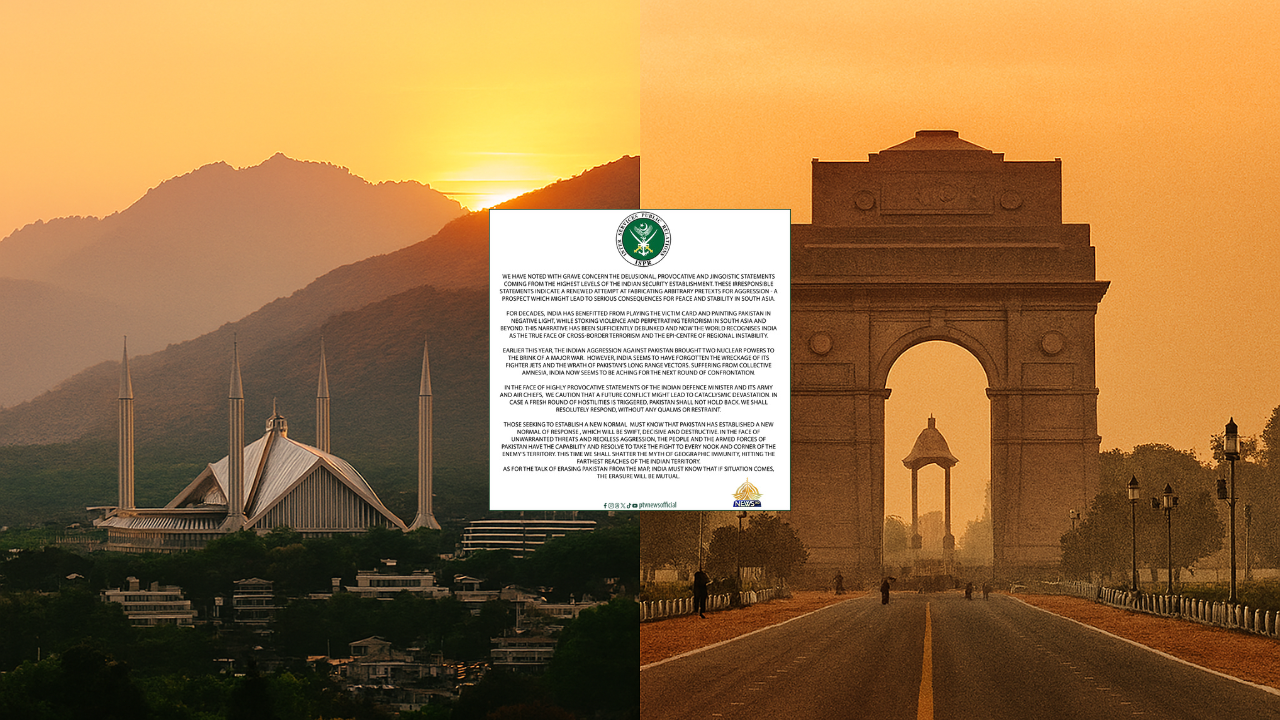
ISLAMABAD: The Pakistan Army on Saturday issued a stark warning that any future confrontation with India could unleash “cataclysmic devastation,” stressing that the country would retaliate with full force and without hesitation.
The statement, released by the Inter-Services Public Relations (ISPR), came in response to a series of aggressive remarks by senior Indian officials including Defence Minister Rajnath Singh and the chiefs of the Indian Army and Air Force.
“In the face of highly provocative statements, we caution that a future conflict might lead to cataclysmic devastation. Pakistan shall not hold back and will respond resolutely, without any qualms or restraint,” the ISPR declared.
Indian media outlet NDTV reported a day earlier that Indian Army Chief General Upendra Dwivedi had warned Pakistan to abandon “state-sponsored terrorism” or risk being erased from the map. He further suggested that Indian forces would “not show restraint this time,” hinting at possible military escalation.
Adding to the rhetoric, Indian Air Force Chief Amar Preet Singh claimed without providing evidence that Indian jets had downed five Pakistani aircraft during the May clashes between the two nuclear-armed rivals. Defence Minister Rajnath Singh also posted a video message on X, asserting that Indian soldiers possessed both “weapons and high morale” to overcome any challenge.
Rejecting these assertions, Pakistan’s military media wing said such “delusional and jingoistic statements” were a dangerous attempt to fabricate pretexts for aggression. The ISPR warned that Pakistan would not only defend itself but also “shatter the myth of geographic immunity by striking deep into Indian territory if forced into war.”
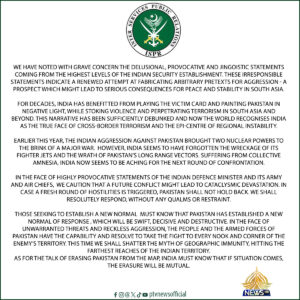
The statement further cautioned that any talk of erasing Pakistan from the map would invite “mutual erasure,” underscoring that Islamabad had established a “new normal” of swift, decisive, and destructive response.
According to Dawn News, the ISPR also reminded India of the recent four-day conflict in May, which brought the two countries to the brink of a major war. Both sides exchanged heavy firepower including fighter jets, missiles, and drones, leaving dozens dead before a ceasefire was reached. Pakistan claimed to have downed six Indian aircraft including a Rafale, while New Delhi admitted only “some losses.”
The May clashes were triggered by an attack on Hindu pilgrims in occupied Kashmir, which India blamed on Pakistan without evidence. Islamabad strongly denied involvement, calling New Delhi’s account “fabricated and misleading.”
In the aftermath of the conflict, Pakistan announced the creation of the Army Rocket Force Command in August, tasked with developing long-range conventional strike capabilities. The new arm is expected to operate ballistic, cruise, and potentially hypersonic missiles designed to hit targets deep inside enemy territory without resorting to nuclear escalation.
The ISPR concluded by warning that India’s “irresponsible provocations” threatened peace and stability across South Asia, adding that Pakistan’s military and nation were fully prepared to take the fight “to every corner of the enemy’s territory” if pushed into confrontation.