



The midday calm of Doha was shattered this past Tuesday, not by the usual hum of prosperity, but by the devastating roar of Israeli fighter jets. In a brazen act that has sent shockwaves through the region, Israel launched a series of strikes on Qatar’s capital, targeting senior Hamas leaders. While Hamas claims its negotiating delegation emerged unscathed, the attack tragically claimed the lives of a Qatari security official and five others, shattering the illusion of impenetrable security in one of the world’s wealthiest nations.
This singular missile attack has “exposed the weakness of Qatar.” It lays bare a profound truth: billions in oil and gas reserves, immense wealth, and even the “American umbrella” cannot provide salvation if a nation cannot defend itself. Qatar, a nation that has skillfully cultivated a complex web of relationships, now finds itself in the unenviable position of being the “unfortunate country whose two friends (Israel and Iran), who are enemies amongst themselves, have targeted it with bombardment.”
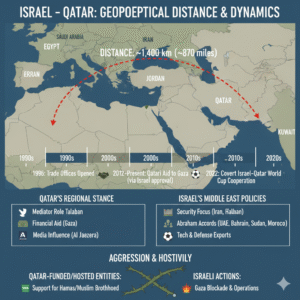
The fundamental question now hanging over Doha is: How can one truly be a friend to everyone simultaneously? The text highlights this seemingly contradictory posture: “America there, the Taliban there, Hamas there, Israel there, Egypt there, the Muslim Brotherhood there…” This attempt to maintain equidistance and influence across deeply opposing factions, while often lauded as astute diplomacy, has demonstrably failed to insulate Qatar from the harsh realities of global power politics.
Israel’s justification for the attack was unequivocal: they targeted “those directly responsible for the brutal massacre of October 7.” The Israeli military claims 15 fighter jets delivered 10 strikes on a single target, a display of overwhelming force. Qatar, reeling from the assault in a residential area, has rightly accused Israel of violating international law.
Adding a layer of complex diplomatic fallout, President Donald Trump has weighed in, distancing himself from the decision. Trump stated emphatically that the attack in Doha was not his call but rather that of Israeli Prime Minister Netanyahu, a decision he “was not happy about.” More critically, Trump revealed he had instructed his Special Assistant Witkoff to inform Qatar about the impending Israeli attack, but “unfortunately, this warning was delayed.”
Trump further emphasized that the bombing within Qatar “does not serve the objectives of Israel or the United States.” While he acknowledged the elimination of Hamas as a “legitimate goal,” he expressed “deep regret” over the attack on Qatari soil, underscoring that Qatar is “an ally and friend of America.” This statement highlights the precarious tightrope walk the US often performs in the region, balancing its strong alliance with Israel with its strategic partnerships with Arab nations like Qatar, which hosts a significant US military presence.
Further complicating the regional picture, the Jordanian armed forces swiftly denied any use of their airspace by Israeli jets for the Qatar operation, labeling such claims as “false and slanderous.” This denial comes amidst a broader wave of condemnation from across the Middle East. On September 9, 2025, numerous Arab nations denounced the Israeli attack on Qatar’s capital.
Jordan’s Ministry of Foreign Affairs issued a strong condemnation, calling it a “dangerous, unacceptable escalation.” Kuwait unequivocally condemned the strike, pledging “full support” for any retaliatory action by Qatar. The Deputy Prime Minister of the United Arab Emirates also voiced condemnation, while Oman’s Ministry of Foreign Affairs declared the Doha attack a “serious violation of Qatar’s sovereignty.” This widespread regional outcry underscores the gravity of the incident and the potential for increased tensions, further isolating Israel diplomatically in the immediate aftermath of its aggressive move.
This incident serves as a stark reminder that true defense is only possible by “keeping one’s own horses ready.” The belief that economic might or the perceived protection of a superpower offers permanent immunity from geopolitical realities has been decisively debunked. Qatar, for all its strategic maneuvering and vast resources, has learned a painful lesson: in the volatile arena of international relations, self-reliance and robust defense capabilities are ultimately the only true guarantors of security. The comfortable illusion of being a universal friend, it seems, can quickly become a dangerous vulnerability, even when an ally attempts to issue a warning that arrives too late.