

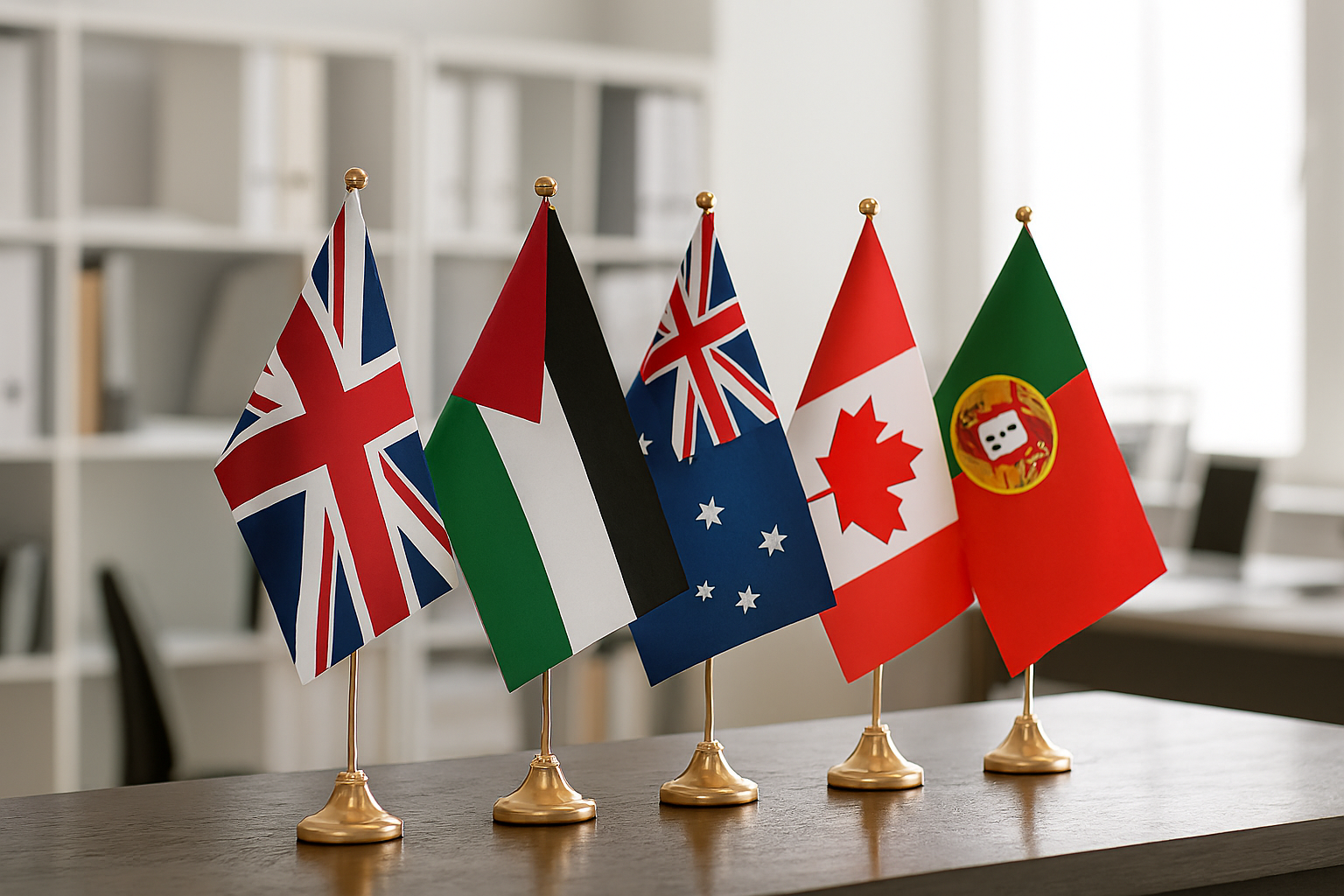
The devastation and deepening humanitarian crisis in Gaza are reshaping the global diplomatic landscape. On Sunday, the UK, Canada, Australia and Portugal officially recognized the existence of a Palestinian state, a move that, according to BBC Urdu, is expected to be echoed by several other nations during the 80th session of the UN General Assembly.
Belgium, France, San Marino, Luxembourg, Malta and Andorra are anticipated to follow suit within hours, with similar signals emerging from Finland and New Zealand.
The UK and Canada’s recognition is particularly notable: the UK is one of five permanent members of the UN Security Council with veto power, while Canada becomes the first G7 nation to take this step. France’s upcoming recognition will leave the United States as the only permanent Security Council member not to recognize Palestine. China and Russia (then the Soviet Union) extended recognition in November 1988, shortly after the Palestine Liberation Organization declared independence in Algeria.
France has pledged unconditional recognition, while the UK’s Labor government cited Israel’s refusal to end the “terrible situation” in Gaza or agree to a ceasefire with Hamas as a key factor. London has urged Israeli Prime Minister Benjamin Netanyahu to halt West Bank annexations and commit to a long-term peace process leading to a two-state solution, a vision it says stands in stark contrast to Hamas’s stance.
Hamas, in response to international demands, insists it will not disarm until an independent Palestinian state is established. Since the Gaza war began, 13 countries including Spain, Ireland, Norway, Slovenia, the Bahamas, Jamaica, Barbados, Armenia and Trinidad have recognized Palestine.
French President Emmanuel Macron, in a statement on X, stressed the urgency of ending the war, protecting civilians, securing a ceasefire, releasing hostages, and delivering humanitarian aid. He also called for Hamas’s disarmament and Gaza’s reconstruction.
Israel’s leadership has rejected these recognitions, warning they could embolden militant groups and create “another Iranian agent” in the region. Netanyahu has argued that a Palestinian state under current conditions would serve as a “launching pad for the destruction of Israel,” claiming Palestinians seek a state in place of Israel rather than alongside it.
What Recognition Means and Its Limits
Recognition by other states is one of four key factors in a nation’s existence, alongside defined borders, population, and sovereignty. Yet, as examples like Taiwan show, recognition does not guarantee UN membership or full state functionality.
For Palestine, UN membership remains elusive due to the Security Council’s approval requirement, and the United States vetoed such a resolution in April 2024. Even with broader recognition, the realities on the ground remain unchanged: Israel controls Palestinian borders, and many international bodies classify it as an occupying power.
The Roadblocks to Peace
The two-state solution, long seen as the most viable path to peace, faces entrenched obstacles:
Israeli settlements in the West Bank and East Jerusalem, home to nearly 700,000 people
Jerusalem’s status, with Palestinians claiming East Jerusalem as their capital, while Israel asserts sovereignty over the entire city
The right of return for an estimated 6 million Palestinian refugees, a demand Israel rejects
Internal Palestinian divisions, with Hamas controlling Gaza since 2007 and the Palestinian Authority governing the West Bank
These political fractures, combined with decades of mistrust, make recognition a symbolic but insufficient step toward resolving the conflict. Without addressing core disputes including borders, security, refugees, and governance, the humanitarian crisis in Gaza and the broader Palestinian question will remain unresolved.