

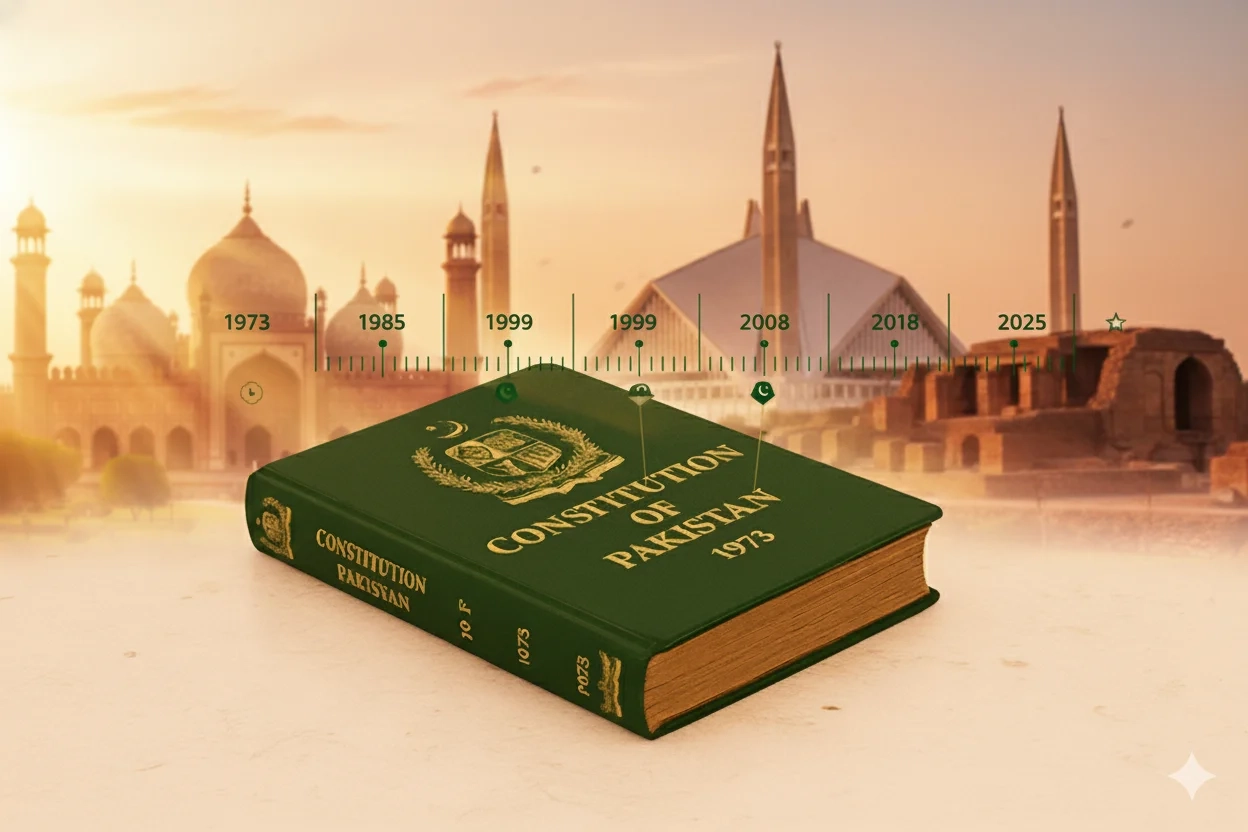
Islamabad: The Constitution of Pakistan, approved in 1973, has undergone a long journey of change over the past 52 years. It has been reshaped through 26 constitutional amendments and nearly 270 article revisions, reflecting the country’s alternating periods of democracy and martial law.
In the early years, Prime Minister Zulfikar Ali Bhutto introduced seven amendments. The First Amendment of 1974 altered 17 articles, recognizing the right to form political parties and requiring disclosure of income sources. The Second Amendment declared certain religious groups as non-Muslims. The Third Amendment extended detention periods for individuals accused of activities against national integrity. The Fourth Amendment exempted presidential orders and regulations from constitutional challenges. Later amendments under Bhutto addressed judicial appointments and procedures for a prime minister’s vote of confidence.
Military rule left a deep imprint. General Zia-ul-Haq introduced amendments that entrenched presidential powers and validated martial law regulations. His government altered the suspended Constitution 97 times, many of which were later ratified through the Eighth Amendment.
Civilian governments sought to restore balance. Benazir Bhutto’s tenure in 1989 brought the Eleventh Amendment, adjusting election cycles. Nawaz Sharif’s governments in the 1990s introduced reforms such as the 13th Amendment, which restored prime ministerial authority, and the 14th Amendment, which enforced party discipline in parliament. The 15th Amendment declared the Quran and Sunnah as the supreme law, while the 16th Amendment set age limits for protection against employment discrimination.
General Pervez Musharraf’s regime introduced the 17th Amendment, granting him the power to dissolve parliament and altering judicial retirement ages. His government suspended the Constitution and made 37 changes, later repealed by the historic 18th Amendment under the Pakistan Peoples Party. That amendment revised 102 articles, curbed presidential powers, and granted provinces greater autonomy in education, health, and governance.
Subsequent amendments continued to refine Pakistan’s democratic framework. The 19th and 20th Amendments strengthened judicial appointments and the Election Commission. The 21st Amendment temporarily empowered military courts to tackle terrorism. Later amendments defined the tenure of election officials, repealed temporary judicial provisions, and adjusted reserved seats for tribal areas.
In 2018, the 25th Amendment reduced the number of National Assembly seats. The most recent 26th Amendment, passed in 2024, set new rules for the appointment of the Chief Justice of Pakistan, established constitutional benches in the Supreme Court, and regulated the transfer of judges in the High Courts.
Together, these amendments illustrate Pakistan’s ongoing struggle to balance civilian authority and military influence. The Constitution remains both a battlefield and a safeguard, reflecting the nation’s evolving democratic aspirations.