

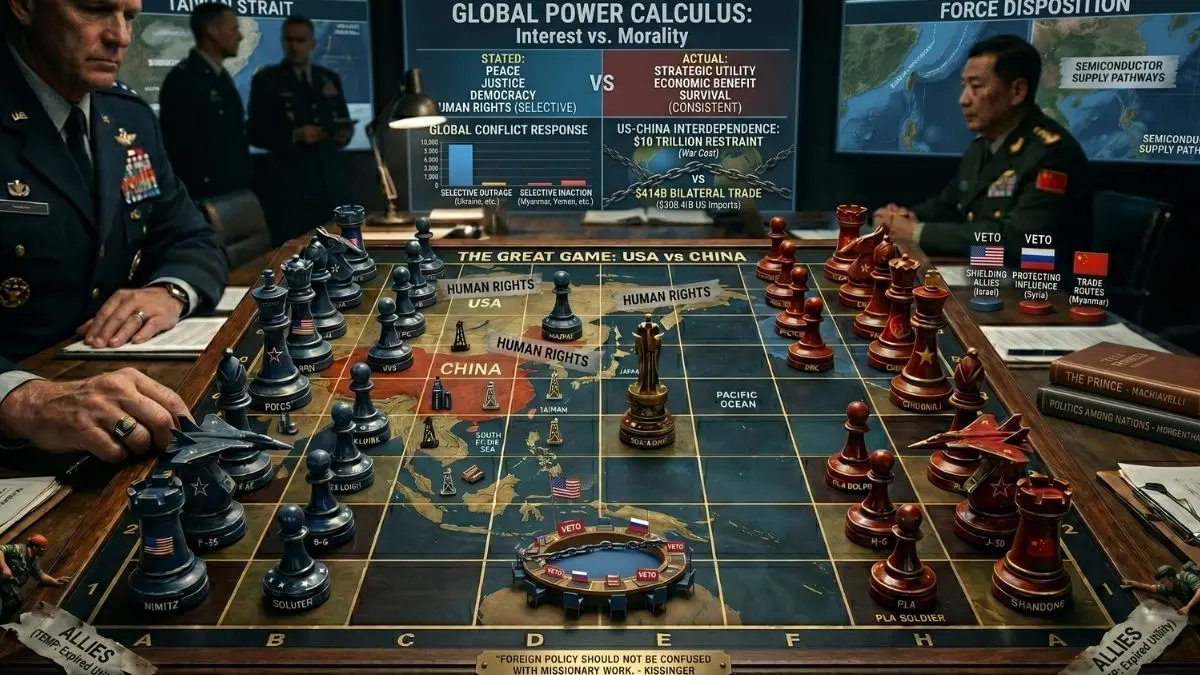

Modern international politics is often described in moral language. Leaders speak of peace, justice, democracy and human rights. Wars are justified as necessary interventions. Sanctions are framed as ethical responses. Alliances are presented as partnerships of shared values.
Yet beneath all this showcase, lies a more consistent and a different pattern that actually tells the truth of international politics. States rarely act because something is right or wrong. They always act because something is strategically useful, economically beneficial or politically beneficial or necessary for survival. This contradiction is not accidental, but it is structural.
A state may condemn war in one region while supporting armed actors in another. It may call for human rights in one country while ignoring violations in another. The language changes, but the logic of interest remains steady .
The Post-9/11 era states show this clearly.
The wars in Iran and Afghanistan resulted in hundreds of thousands of direct deaths and long-term instability across entire regions.
Financial costs excluded trillions of dollars.
Yet these interventions are always shown globally as moral and security needs, not as geopolitical strategies.
International Relations are best described or understood by Realism – It states that States always prioritize their interests, moral principles might be important but they come after interests. Thinkers like Niccolò Machiavelli and Hans Morgenthau argued that political action is shaped less by ideals and more by necessity.
In History, the best example for this framework is Cold-War. It is stated that the Cold War (1947-1991) was about ideology, but a critical analysis, but was it really about ideology? Was the Cold War really about Capitalism and Communism? Cold War was ideological war, it is was merely a marketing strategy, in reality, it was classic, ruthless struggle for global hegemony, resources , geopolitical, real estate and power.
Nothing exposes the reality of world or international relations other than shifting alliances of the 20th Century. In WWII, both the
The US (Capitalist state) and USSR (Totalitarian State) were allies as they wanted to defeat Germany (their common enemy). As Germany got defeated, common enemy go away and the interests of both states were no longer same, at that time during WWII, their ideologies were different but were still allies.
After WWII ended, the race for global hegemony began, and suddenly yesterday’s brothers-in-arms, realized they are having different ideologies ,and turned into bitter rivals of the Cold War. The harsh reality is that alliances are built on shared enemies or interests not shared values. If the Cold War was actually an ideological war, why did the superpowers completely ignore or betray their allies the moment they lost their material utility.
During the Cold War, Kurdish people in Iraq wanted to rebel against Iraq’s government backed by the Soviet Union, Kurds asked for military and financial help from the U.S, offering loyalty. The US and its ally Iran temporarily used the Kurds to weaken Iraq. But the moment Iraq and US ally Iran signed a border agreement in 1975, the US suddenly lost all strategic benefit from helping Kurds. The US instantly cut off aid and left it crushed by the Iraqi Military. When asked about it, US Secretary of state, Henry Kissinger coldly stated;
“Foreign policy should not be confused with missionary work.”
The same thing was done by the USSR too, as when the Communist Party of Philippines fought a massive guerilla war against the brutal, US backed dictator Ferdinand Marcos. The USSR looked at the map. They saw Philippines was deep within the US sphere of influence, and has many American bases, USSR, saw no realistic way to gain power there without risking direct power war with America. As a result, the Soviets completely ignored their fellow communists. In fact, to maintain stable trade relations, Soviet diplomats visited Marcos and praised his regime, totally abandoning the local communist rebels. So, Was really the Cold War a war of ideology or power control?
In International politics, peace only lasts among the states till they share the same interests, not because they have the same values. The modern states consistently use moral language in public diplomacy. However, actual policy decisions are shaped by strategic calculation. The responses to global crises vary significantly depending on political alliances, economic dependencies and geopolitical value. Some conflicts generate immediate sanctions and global outrage, while others receive limited attention. This inconsistency is not random. It reflects the selective nature of international politics.
If world politics was about morality or about ideological incompatibility, the United States and China would likely already be engaged in direct military confrontation. Their political systems differ fundamentally, and strategic rivalry between them continues to intensify across trade, technology, military expansion and regional influence. Yet after all these tensions Both states remain deeply economically interconnected, why? It is because they have interests.
According to Official data -from the U.S Census Bureau and the United States Representative (USTR), even with heavy political tensions and tariffs, the US imported $308.4 billion worth of goods from China in 2025 alone.
Other than that, The total bilateral trade (exports plus imports) between the two nations is over $414 billion. This statistics show that it is all because China desperately needs American consumers to buy its manufacturing output and the U.S. consumer economy relies completely on Chinese electronics, machinery and components to keep running their country. This interdependence creates a powerful restraint on direct conflict. The economists estimate that a direct war between the US and China (for example over Taiwan) would instantly shatter the trade engine and wipe a staggering $10 trillion from the global economy-equivalent to roughly 10% of global trade . It is such a big loss that it could take decades or even more than that to recover the word and the economies of both countries. In this sense, modern peace is often preserved less by ideological harmony and more by the immense economic cost of war itself. This proves that even rivals cooperate when interest becomes too expensive to destroy.
Many people believe global institutions exist to protect justice, peace, and human rights equally. However, the modern international system was largely built around power and national interests. The clearest example. is the United Nations Security Council, where five parament members – the US, Russia, China, the UK and France- hold veto power. This means even if most countries support a resolution, a single major power can block it when its own strategic interests are threatened. Since 1945, the veto has repeatedly shown how interest outweighs morality in global politics. The United States has frequently used its veto power to shield Israel from resolutions and cease fire demands, prioritizing a long standing strategic alliance. Russia has blocked resolutions related to Syria and Ukraine to protect its military and political influence. China has resisted stronger action against Myanmar, where it has major trade routes and infrastructure investments connected to the Indian Ocean. These examples show that international institutions do not operate above power, they function within it. The global order was not to built to eliminate self-interest, but to manage competition among Powerful States and reduce the chances of direct conflict. In the end, even the world’s largest peace institutions reveal the same reality; peace is often preserved not by morality alone , but when stability becomes more beneficial than war.
Morality is not absent from International Politics, but it works within limits. Humanitarian aid, international law and peacekeeping efforts show that ethical concerns do shape global actions, yet mostly when they align with strategic interests. When morality and interest clash, interest usually dominates, making morality conditional rather than decisive. Across history – from colonial empires and Cold War rivalries to failed interwar treaties and modern sanctions- the some pattern repeats; states priorities interests, while morality often becomes the justification. Peace is rarely a permanent moral outcome, but a temporary balance of aligned interests. When interests align, peace emerges; when they don’t tension returns. And in that sense, peace is not born from morality. It is born from interest.