
 Ai
Ai

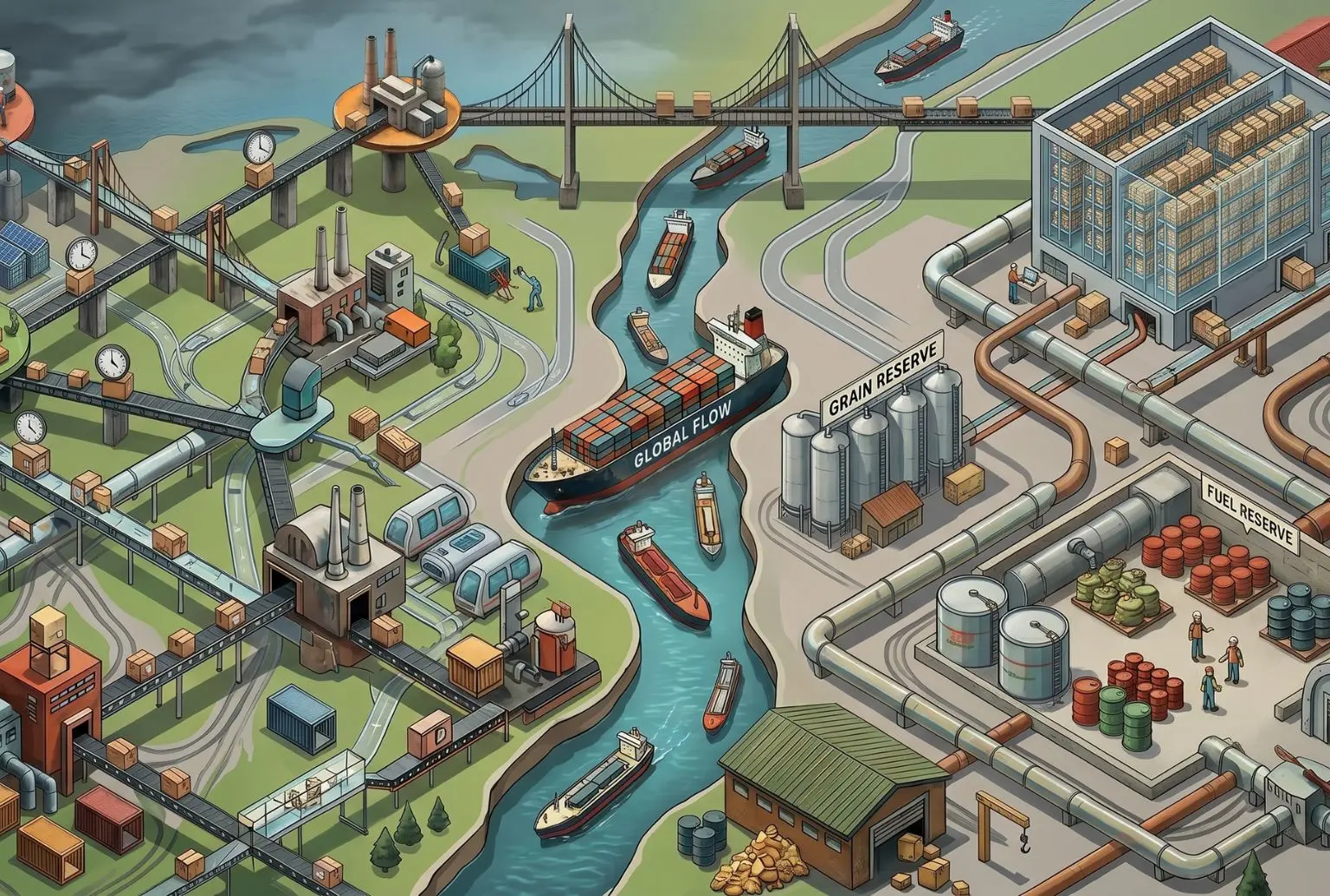
The time in which goods travel faster than ever before in the world, where a product designed in one continent is manufactured in another and sold across the world has become effortlessly connected. But beneath this smooth surface lies a reality that is far less stable. The global system that appears efficient is also deeply fragile – it is so fragile that a single disruption in one part of the world can send its effects across every continent.
A blocked canal, a political conflict and sanctioned trade route, or even a delay in shipping is enough to expose how dependent modern economies have become on a few critical pathways .
Globalization, once celebrated as the ultimate strength of interconnected economies, is now being questioned for the very same reason; its dependence on thin, vulnerable links.
Globalization initially was a great tool to strengthen the relations, to connect regions, to increase economies and to reduce costs.
For decades it worked and globalization proved that it’s a powerful tool to connect regions . Countries specialized in what they produced best, and global supply chains reduced costs significantly. The biggest advantage of globalization was considered wider access to resources but is it true did globalization gave wider access to resources? Globalization was mainly adopted to connect the countries, but it came with a hidden reality too. The global system increasingly relied on; limited trade routes, centralized production hubs, and just-in-time (JIT) supply chains.
This means instead of having strong backup systems that could be useful during crises, the world began operating like a tightly wound network-fast but extremely sensitive to disruption. A single delay no longer affected one country, it affected the entire chain.
The biggest thing for which the whole world accepts globalization is trade.
Trade is a powerful tool in modern globalized world it has more power than military in continuously changing the nature of world . So, modern globalization depends heavily on strategic maritime choke-points – narrow passages through which a large portion of global trade flows. These include canals and straits that act as lifelines of international commerce.
One of the most critical examples is the Suez Canal that connects Europe and Asia. In March 2021,the 400-meter Container ship named Ever Given was stuck in the Suez Canal due to strong storm blocking one of the world’s most important routes. This canal (Suez) handles about 12-13% of global maritime trade, and the blockage lasted for six days, stopping all traffic. More than 400 ships were stuck waiting to pass, it created a lot problems for other ships .
The disruption delayed an estimated 9-9.6 billion dollars worth of goods per day, adding pressure to already strained global supply chains during COVID-19. Many ships had to re-route via Cape of Good Hope (the longer route) increasing travel time by about
10-14 days and raising transport costs significantly. This incident revealed that the global economy does not have multiple equal alternatives – it relies heavily on a few narrow corridors.
To know how fragile global systems can be the example of the 1973 oil crisis is present , when Arab members of OPEC imposed an oil embargo on several western countries as they were supporting Israel in Yom Kippur War. This sudden restriction causes:
- Sharp increase in oil prices.
- Energy shortages in major economies
- Economic slowdown across industrial nations.
It was one of the earliest examples of how political decisions in one region could destabilize economies worldwide .
This incident gives a clear lesson to the world: Dependence on a concentrated source of essential goods creates systemic vulnerability.
The COVID-19 pandemic exposed another weakness in global systems. Factories shut down, shipping slowed and production centers faced disruption. As a result, shortages emerged in;
- Medical Equipment
- Medicines
- Electronics
- Basic Consumer Goods.
These kind of incidents exposes the weakness of Just -in-Time (JIT)
systems, where companies keep minimal stock and rely on continuous supply. For decades, countries operated on a Just-in-time (JIT) model, where efficiency was prioritized over storage. Goods arrived exactly when needed, reducing costs and increasing speed.
However, the drawback of this system is that it collapsed under global shocks .
In response, when countries saw and analyzed the drawback of this JIT model, countries and industries made shift towards a Just-in-Case (JIC) approach, which involves maintaining extra stock and backup systems, that can be beneficial in the time of global shocks or even during some disaster in the country like Flood, Earthquake.
For example;
- Countries are increasing strategic reserves of food and fuel.
- Companies are diversifying suppliers.
- Governments are reducing dependency on single regions.
Countries like Japan and Germany are actively investing in supply chain diversification strategies.
A clear example of the shift from Just-in- Time (JIT) to Just-in-Case (JIC) can be seen in Japan, which was once a global leader in lean, highly efficient supply chains. Its industries, especially automobiles, relied on JIT systems with minimal inventory to reduce costs.
However, the 2011 Earthquake and Tsunami disrupted key suppliers , including Semi-conductors production, causing major global manufacturing delays and exposing the risk of over-dependence.
After this crisis, Japan shifted toward a hybrid model by introducing Just-in-Case (JIC) strategies including safety stock of critical parts and diversified suppliers across regions. This approach helped to stabilize production during later shocks like COVID-19 pandemic, when many countries faced severe shortages. The lesson the world came to know through this was efficiency reduces cost but resilience ensures stability in crisis .
The recent geopolitical tensions in the Middle East have further exposed the fragile nature of globalization. Ongoing tensions between United States – Iran along with wider Israel regional conflicts, have created tensions in global energy markets and trade routes. Even without direct war, the fear of escalation has been enough to raise shipping costs, insurance rates and oil prices.
A large share of global energy and trade passes through sensitive regions such as the Strait of Hormuz, small disruptions or threats quickly affect the world economy. It shows how deeply interconnected the global system is conflicts in one region do not remain local, but instead lead to rising prices, supply chain delays and financial pressure for ordinary people worldwide.
In such a globalized world, a realistic approach is not extreme dependence on either system but a balanced model. Countries should go with the balance approach:
- Diversify supply chains instead of relying on single source.
- Maintain strategic reserves of essential goods.
- Develop alternative trade routes beyond key choke-points.
- Strengthen regional trade partnerships.
- Include flexibility in international agreements for crisis situations.
While this approach can increase costs due to longer routes and storage needs, it reduces the risk of total disruption during emergencies. The higher costs are acceptable if they ensure stability during a crisis.
Globalization has transformed the modem world making it faster, cheaper and more connected than ever before. But beneath this success lies a fragile system that depends heavily on uninterrupted flows of trade, energy and goods.
From blocked canals to energy crises , from pandemics to geopolitical conflicts, recent history has repeatedly shown that even small disruptions can have global consequences.
The world is not less connected it is more connected than ever and with the time globalization will have more influence and it would increase too.
But that very connection has made it more sensitive, more interdependent and more vulnerable.
The challenge for the future is not to reverse globalization but to rebuild it on stronger and more balanced foundations. Because in an interconnected world, stability is no longer optional it is essential.